
Sunrise 2027 Is Coming. Is Your Retail Scanning Infrastructure Ready for 2D Barcodes?
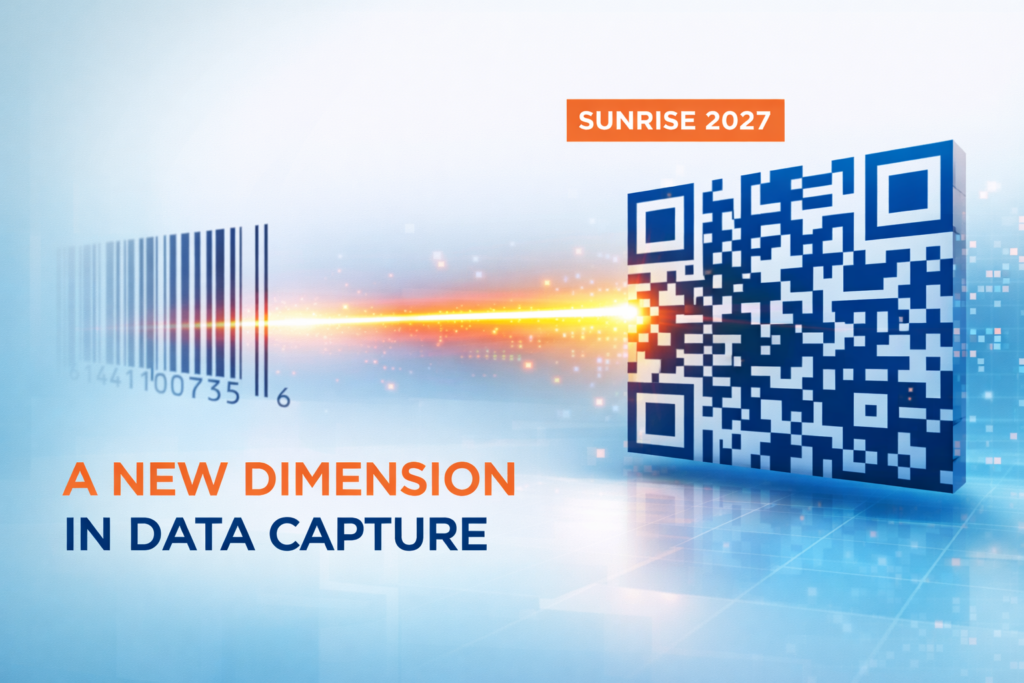
For 50 years, the 1D barcode did one job: identify a product at checkout. A series of vertical lines encoding a GTIN. One scan, one price lookup. Simple. That era is ending and Sunrise 2027 retail scanning is coming fast.
GS1’s Sunrise 2027 initiative sets a deadline: by December 31, 2027, retailers must have the hardware and software infrastructure in place to read 2D barcodes at checkout. QR codes. GS1 DataMatrix. Formats that carry not just a product identifier, but lot numbers, expiration dates, serial numbers, and URLs, all in a single code.
This is not a suggestion. Major retailers including Walmart, Wegmans, and Dillard’s have signaled that 2D barcodes will become a requirement for product listings. Brands that cannot comply risk losing shelf space.
But while most of the Sunrise 2027 conversation focuses on point-of-sale scanners and packaging changes, there is a bigger operational question that retailers and their supply chain partners need to answer: what happens to scanning across the rest of the operation?
The POS Problem Is Just the Surface
Upgrading checkout scanners to read 2D barcodes is the most visible piece of Sunrise 2027 compliance. It is also the most straightforward. Modern imaging scanners at POS can already read both 1D and 2D codes. For many retailers, the checkout hardware is either ready or close to ready.
The harder challenge is everything that happens before a product reaches the register.
Receiving docks. Backroom inventory. Cycle counts. Replenishment. Returns processing. Every one of these workflows involves barcode scanning, and most of them still run on one-at-a-time handheld guns designed for linear barcodes.
When products start carrying 2D codes packed with serialized data, batch numbers, and expiration dates, those back-of-house scanning workflows need to capture and process that richer data set. A warehouse worker scanning inbound pallets is no longer just confirming a GTIN. They are potentially capturing lot-level traceability data that feeds compliance systems, inventory accuracy tools, and loss prevention analytics.
One-at-a-time scanning was barely keeping up with 1D barcodes. Adding 2D data density to the same manual process will slow operations further, not accelerate them.
Why Sunrise 2027 Is Really a Data Capture Problem
The shift from 1D to 2D barcodes is often described as a hardware upgrade. Replace the laser scanner with an imager. Update the POS software. Done.
In reality, Sunrise 2027 is a data capture problem. 2D barcodes carry significantly more information than their 1D predecessors. A single GS1 DataMatrix or QR code can encode a GTIN, lot number, expiration date, serial number, and a GS1 Digital Link URL, all in one symbol. That data richness is the entire point of the transition.
However, more data per barcode means more processing per scan. And when your operation is still scanning items individually across receiving, inventory, and fulfillment workflows, the volume of data capture events multiplies alongside the data density per event.
Consider inbound receiving for a retailer processing hundreds of pallets daily. Each case on every pallet now carries a 2D code with embedded lot, batch, and expiration data. Scanning those cases one at a time to capture and route that data into the inventory management system is the same bottleneck that existed with 1D codes, except now each scan carries more data that needs to be parsed, validated, and stored.
The retailers who will move through this transition smoothly are the ones who solve the capture bottleneck, not just the code format.
How Vision AI Solves Both Problems at Once
Vision AI is purpose-built for the scanning environment that Sunrise 2027 creates: high data density, high volume, and the need to capture multiple data points simultaneously.
Instead of scanning each product individually, Vision AI captures every visible barcode in a single image. It does not matter whether those codes are 1D, 2D, or a mix of both, which is exactly the dual-labeling reality that will define the transition period. The system reads everything in the frame simultaneously, parses the embedded data, and routes it to the appropriate systems.
At QicScan AI, this is how our platform operates. QicScan uses proprietary Vision AI on standard Android devices to capture barcodes, product counts, images, and label data in a single handheld scan. The system reads 1D and 2D codes simultaneously, extracts embedded GS1 data elements like GTIN, lot number, and expiration date, and delivers a complete, structured data package to the WMS or inventory management system.
For retailers preparing for Sunrise 2027, this means the transition from 1D to 2D does not add scanning time. It reduces it. Instead of adapting an already slow one-at-a-time process to handle richer data, Sunrise 2027 retail scanning compresses into a single capture event that processes all code formats and all data elements at once.
Customers using QicScan typically see a 50–70% reduction in inventory handling time, regardless of whether the products carry 1D codes, 2D codes, or both.
Where Retailers See the Impact
Receiving and backroom inventory is where the Sunrise 2027 scanning challenge hits hardest for retailers. Inbound product now carries richer data that needs to be captured accurately at the point of receipt. Vision AI handles this by capturing entire cases or pallets in a single image, extracting all embedded data elements automatically.
Cycle counts become more practical. When scanning is faster and captures more data per event, full-store or full-section counts become less disruptive. Teams can verify inventory with lot-level and expiration-level detail without adding hours to the count process.
Shrink and loss prevention improve because 2D codes enable serialized tracking at the item level. Vision AI captures that serialized data as part of the standard scanning workflow, giving loss prevention teams granular visibility without adding manual steps.
Returns processing accelerates. Returned products carrying 2D codes with batch and expiration data can be scanned, verified, and dispositioned in a single capture rather than requiring multiple manual checks.
The dual-labeling transition period becomes manageable. During the years when products carry both 1D and 2D codes, Vision AI reads both formats simultaneously. There is no need for workers to determine which code to scan or switch between scanning modes.
The Timeline Is Shorter Than It Looks
December 2027 sounds distant. But for retailers with hundreds or thousands of locations, each running scanning workflows across receiving, inventory, replenishment, and returns, the operational changes go well beyond swapping out a checkout scanner.
The retailers who treat Sunrise 2027 as a POS upgrade will get the checkout piece right and struggle with everything behind it. The retailers who treat it as an opportunity to modernize data capture across the entire operation will come out faster, more accurate, and better positioned for the serialized, data-rich supply chain that 2D codes make possible.
QicScan AI deploys on the Android devices your teams already use. No specialized hardware. No infrastructure overhaul. The platform handles 1D and 2D codes simultaneously, captures all embedded GS1 data elements, and delivers measurable results within weeks.
If your retail operation is still planning for Sunrise 2027 one scanner at a time, the bottleneck is not the barcode format. It is the capture process.
See how QicScan handles Sunrise 2027 retail scanning → Book a demo
QicScan AI uses Vision AI to automate inventory scanning, counting, and tracking for retailers, with built-in support for 1D and 2D barcode formats as the industry transitions to Sunrise 2027. Learn more at qicscan.ai.
