
Why Vision AI Is Replacing Manual Handgun Scanning in Warehouses, Distribution Centers & Retail Stores
Pick up a case. Scan. Set it down. Pick up the next one. Scan. Set it down. Repeat.
For decades, this has been the rhythm of warehouse inventory management. It works. But it was never designed for the volume, speed, and accuracy that modern supply chains demand.
A single pallet with 42 cases means 42 individual scans. A warehouse processing 300 pallets a day is looking at over 12,600 manual scans — just on the receiving dock. That number doubles when you add outbound verification.
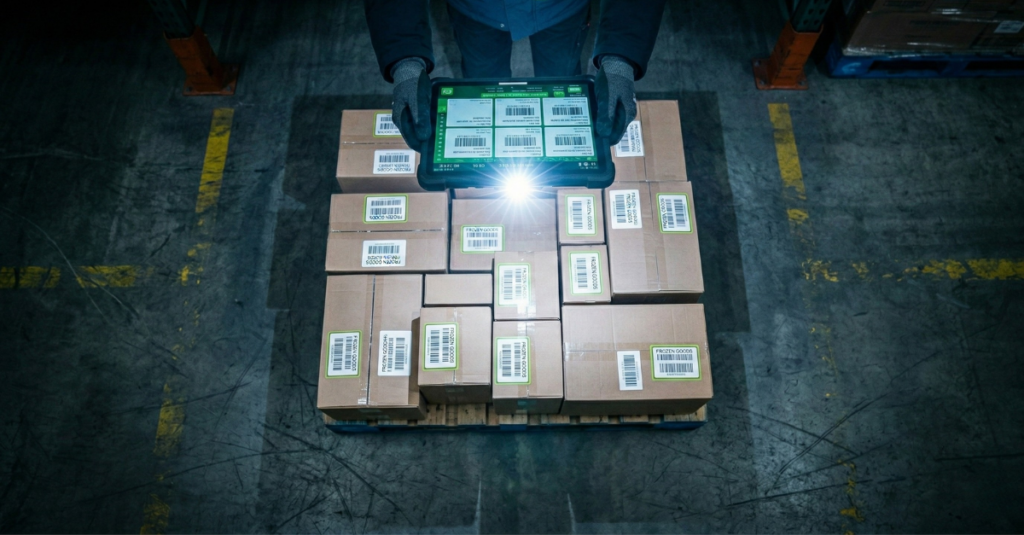
Vision AI warehouse scanning eliminates this bottleneck by capturing entire pallets in a single handheld scan.
The process is functional, but it is also one of the largest sources of hidden labor cost in distribution. And it is exactly the kind of repetitive, high-volume task that Vision AI was built to replace.
What Is Vision AI — and Why Does It Matter for Warehouses?
Vision AI combines machine learning with high-resolution imaging to interpret what a camera sees in real time. In warehouse applications, that means a handheld device or mounted tablet can look at a pallet, a tote, or a pack station and simultaneously capture every visible barcode, count items by object detection, and store product images — all from a single snapshot.
This is fundamentally different from traditional barcode scanning, which operates on a one-item-at-a-time model. Laser scanners read one barcode per trigger pull. Even modern 2D imagers still require individual alignment with each label.
Vision AI removes that constraint entirely. Instead of scanning items sequentially, it processes the entire visual field at once. The result is not a small incremental improvement. It is a structural change in how inventory data gets captured.
The Real Cost of One-at-a-Time Scanning
The inefficiency of manual scanning is easy to underestimate because it is distributed across every shift, every dock, and every workflow in the facility.
Consider what happens at a typical receiving dock. A pallet arrives. A worker unpacks or rotates cases to expose barcodes. Each case is scanned individually with a handheld gun. If a barcode is damaged or unreadable, the worker manually keys in the data. Once scanning is complete, the worker may also need to take photos separately for documentation or compliance purposes. Then counts are verified against a manifest — often by hand.
This sequence introduces multiple points where errors compound. Duplicate scans. Missed scans. Mismatched counts. Transposed digits on manual entries. Each one creates downstream corrections that consume additional time and erode data integrity in the WMS or ERP system.
Multiply this across receiving, putaway, cycle counts, pick-and-pack, and outbound verification, and the total labor hours consumed by repetitive scanning become significant — often representing one of the largest controllable operating costs in a distribution center.
How Vision AI Warehouse Scanning Changes the Workflow
With Vision AI-based scanning, the workflow compresses dramatically. A worker points a tablet or handheld device at a pallet and captures a single image. The system simultaneously reads every visible barcode, counts the cases using object detection, and stores a timestamped photo of the pallet — all in one capture event.
There is no need to handle individual cases. No rotating packages to find labels. No separate photo documentation step. The data flows directly into the WMS, ERP, or track-and-trace system with a complete audit trail attached.
At QicScan AI, this is exactly how our platform operates. QicScan uses proprietary Vision AI to capture barcodes, product counts, and images simultaneously on standard Android devices — tablets and phones that warehouse teams already own. There is no specialized hardware to install. No infrastructure changes required. The software runs on the device itself using edge computing, which means it works even in facilities with intermittent WiFi connectivity.
Customers using QicScan typically see a 50–70% reduction in inventory handling time. In practical terms, a receiving process that previously required 5–6 minutes per pallet can drop to seconds. That is not optimization. That is workflow redesign.
Where the Impact Shows Up
The benefits extend beyond raw time savings. When scanning becomes faster and more accurate at the point of capture, the effects cascade through the operation.
Receiving and inbound QC is where the largest time savings typically appear. Instead of 32 discrete scans on a standard pallet, teams capture everything in a single image. Dock-to-stock time compresses, and the receiving bottleneck that backs up inbound logistics begins to clear.
Pick, pack, and ship workflows benefit from the same principle. Pack station workers verify multi-item orders in a single capture instead of scanning each item individually. Rescan rates drop. Congestion at pack stations decreases.
Cycle counts and inventory audits become less disruptive. Vision AI enables faster full-count verification without pulling workers off primary tasks for extended periods.
Compliance and traceability improve because the system captures and stores product images alongside barcode data automatically. For industries with regulatory requirements — pharmaceutical distribution under DSCSA, food supply chains under FSMA — this audit-ready documentation is captured as a byproduct of the scan, not as a separate manual step.
Data quality at the edge gets stronger. When the capture process is automated and multi-point, the data entering the WMS or ERP is more complete and more accurate from the start. Downstream corrections, inventory discrepancies, and dispute resolution all decrease.
Why Now?
The convergence of several factors is making Vision AI adoption practical for distribution operations of all sizes.
First, the devices are already in the building. Modern Android tablets and phones have the camera resolution and processing power to run Vision AI workloads locally. There is no need for fixed infrastructure, conveyor-mounted cameras, or enterprise hardware investments.
Second, labor pressure is not easing. Warehouses continue to face hiring challenges, rising overtime costs, and higher expectations for throughput — all while trying to maintain accuracy. Removing thousands of repetitive manual scans per day directly reduces the labor burden without adding headcount.
Third, compliance requirements are tightening. DSCSA serialization in pharma, FSMA traceability in food, and growing retailer mandates around inventory accuracy all require better data capture at the item level. Vision AI meets these requirements as a built-in function of the scanning process, not as an add-on.
The Bottom Line
The one-at-a-time barcode scanning model was built for a simpler era of distribution. It served its purpose. But in high-volume warehouses processing hundreds of pallets daily, it has become one of the most labor-intensive and error-prone steps in the operation.
Vision AI warehouse scanning replaces that model by capturing everything — barcodes, counts, images — simultaneously in a single handheld scan. The math is straightforward. Fewer touches. Faster throughput. Better data. Lower cost.
QicScan AI is built on this principle. Our Vision AI platform deploys on the devices your team already uses, delivers results in weeks, and typically reduces inventory handling time by 50–70%.
If your warehouse is still scanning one case at a time, the question is not whether to make the shift. It is how much handling time you are leaving on the table every day.
Ready to see it in action? Book a demo →
QicScan AI uses Vision AI to help warehouses, distributors, and 3PLs automate inventory scanning, counting, and tracking with a single snap. Learn more at qicscan.ai.
