
Why 3PLs and Cold Storage Operators Cannot Scale with One-at-a-Time Scanning
Running a warehouse is hard. Running someone else’s warehouse, with their rules, their labeling standards, and their compliance requirements, is harder. 3PL scanning automation simplifies these processes.
That is the reality for every 3PL and cold storage operator. Multiple clients, multiple SKU sets, multiple barcode formats, label placements, and documentation requirements – all running through the same facility, on the same docks, handled by the same teams.
One-at-a-time barcode scanning was already a bottleneck in single-tenant warehouses. In a multi-client 3PL environment, it becomes one of the largest sources of labor waste, error risk, and client friction in the operation.
The Multi-Client Scanning Problem
In a dedicated warehouse, scanning workflows are built around one set of products, one labeling standard, and one set of compliance requirements. Workers learn the patterns. Processes stabilize. Efficiency improves over time.
3PLs do not have that luxury.
A single receiving dock might process inbound pallets for a pharmaceutical client requiring DSCSA-compliant serialized scanning in the morning, a food client requiring lot-level traceability for FSMA in the afternoon, and a retail CPG client with standard UPC verification in between.
Each client brings different barcode formats: 1D, 2D, GS1-128, DataMatrix, sometimes proprietary codes. Label placement varies. Some clients require photographic documentation of every inbound pallet. Others require specific data fields captured and routed to their own WMS or track-and-trace platform.
Workers scanning one case at a time need to know which client’s rules apply to which pallet, which fields to capture, and which system to route the data to. That cognitive load, layered on top of the physical repetition of individual scanning, creates a compounding inefficiency that grows with every new client the 3PL onboards.
The math tells the story. If a single-client warehouse processing 200 pallets daily at 42 cases per pallet runs 8,400 manual scans, a 3PL running three clients through the same facility at similar volume is approaching 25,000 daily scans, each with client-specific requirements attached.
Cold Storage Adds Another Layer
For 3PLs operating cold storage and frozen environments, the scanning problem intensifies.
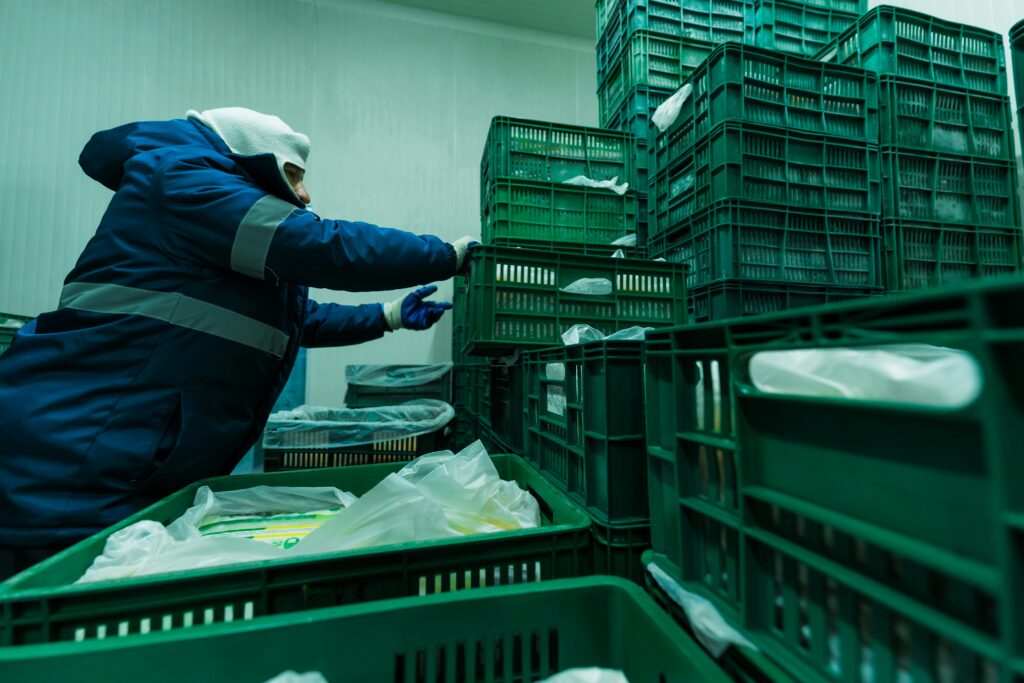
Workers in refrigerated or frozen zones are wearing gloves. Dexterity is reduced. Handheld scanner trigger pulls become slower and less accurate. Screen interactions on mobile devices are harder. Fatigue sets in faster because of the physical demands of working in cold environments.
Connectivity compounds the issue. Cold storage facilities are notoriously difficult WiFi environments. Thick insulated walls, metal racking, and temperature differentials create dead zones and intermittent connections. Scanning devices that rely on continuous network connectivity for real-time data validation experience delays, timeouts, and failed uploads.
Every minute a worker spends in a cold zone is more expensive than a minute on an ambient dock, both in labor cost and in the physical toll on the team. Slow, repetitive scanning in those environments is not just an efficiency problem. It is a workforce sustainability problem.
How Vision AI Changes the Equation for 3PLs
Vision AI addresses the core challenge that makes 3PL scanning uniquely difficult: the need to capture different data, in different formats, for different clients, all from the same workflow.
Instead of scanning each case individually and manually routing data to the correct client system, a Vision AI-equipped device captures every visible barcode on a pallet in a single image. The system simultaneously reads 1D and 2D codes regardless of format, extracts embedded data elements, counts items through object detection, and stores a timestamped photo of the pallet as received. All of this data can then be structured and routed based on client-specific rules.
At QicScan AI, our platform is built for exactly this kind of multi-format, multi-client environment. QicScan runs on standard Android tablets and phones, using proprietary Vision AI to capture barcodes, product counts, images, and label data simultaneously in a single handheld scan.
For cold storage operations specifically, QicScan’s edge computing architecture processes data on the device itself rather than relying on a constant network connection. Workers can scan in freezer zones, walk-in coolers, and refrigerated docks without worrying about WiFi dead zones or upload failures. Data syncs automatically when connectivity is restored.
Customers using QicScan typically see a 50–70% reduction in inventory handling time. For 3PLs, that reduction multiplies across every client, every dock, and every shift.
Where 3PLs See the Biggest Impact
Client onboarding accelerates. Adding a new client to the operation no longer means retraining the scanning workflow from scratch. Vision AI captures all barcode formats and data elements from a single scan. The configuration is in the software, not in the worker’s memory.
Receiving throughput increases across all clients. Instead of 42 individual scans per pallet (multiplied by three or four clients per shift), teams capture entire pallets in seconds. Dock congestion decreases. Staging areas clear faster. Inbound velocity improves regardless of which client’s product is arriving.
Cold storage dwell time drops. Faster scanning means less time per worker in refrigerated and frozen zones. Product reaches proper storage temperature faster, and the physical burden on the team decreases.
Compliance documentation becomes automatic. Whether the client requires DSCSA serialization data, FSMA lot-level traceability, or standard receiving photos, the Vision AI capture event generates all required documentation as a byproduct of the scan. There is no separate compliance step. The data is captured, structured, and audit-ready from the moment it enters the system.
Error rates decrease across the board. When scanning is automated and multi-point rather than manual and sequential, the duplicate scans, missed scans, and mismatched counts that generate client chargebacks and dispute resolution cycles drop significantly.
Labor allocation becomes more flexible. Workers no longer need deep familiarity with each client’s specific scanning requirements to be productive on the dock. 3PL scanning automation through Vision AI handles the complexity at the software level, so operations teams can deploy workers where they are needed without client-specific training overhead.
The Scale Problem
The fundamental challenge for 3PLs is that one-at-a-time scanning does not scale with client growth. Every new client adds scan volume, data complexity, and compliance requirements. If the capture process remains manual and sequential, the only way to handle growth is to add labor. And in an industry already facing hiring pressure and margin compression, that approach has a ceiling.
3PL scanning automation through Vision AI removes that ceiling. The same single-capture workflow handles one client or ten. The same device reads every barcode format, and the same scan event produces compliance documentation for pharma, food, retail, or any other vertical.
QicScan AI deploys on the Android devices your teams already carry. No specialized hardware for each client. No infrastructure changes for cold zones. The platform installs quickly, integrates with existing WMS platforms, and delivers measurable results within weeks.
If your 3PL is adding headcount to keep up with scanning volume instead of automating the capture process itself, the bottleneck is not your team. It is the workflow.
See how QicScan works in multi-client 3PL environments → Book a demo
QicScan AI uses Vision AI to automate inventory scanning, counting, and tracking for 3PLs and cold storage operators, with built-in support for multi-client workflows, multi-format barcodes, and edge computing for low-connectivity environments. Learn more at qicscan.ai.
